As part of our “get to know you” series we are going “Around The Grounds” to find out more about our clubs across the county.
In our first in the series we spoke to several members of the Reading RFC club on all manner of questions.
When was Reading RFC founded?
Reading Rugby Football Club was formed initially as Berkshire Wanderers in July 1898 when RFU president Roger Walker , RFU secretary G Rowland-Hill and Cambridge Blue GR Joyce held a meeting in Pangbourne. Their aim was to set up a rugby club in Reading and the first game was played at the county cricket ground, Kensington Road, Reading in September of the same year.
It was reported that “no such galaxy of talent had ever been seen on a Rugby Football field in the district.” The Wanderers, 19-6 winners against London XV, had no lack of star players with four England internationals in their side, full back Field, centre Leslie-Jones, fly half Rotherham and forward Jacob.
After that scintillating start, Reading led a somewhat nomadic existence with games being played between the wars at Prospect Park and Palmer Park, both council grounds. This limited the Wanderers’ chance of progress although the fixture list did contain many big names, such as Richmond. They also ran a Wednesday side as in those days many shops and businesses closed on Wednesday afternoons.
A big step forward was made just before the Second World War when they moved to their present headquarters at Holme Park Sonning. The club’s name was changed to Reading in 1956, explicitly to prevent the club which was to become Abbey, now known as Reading Abbey, taking the name.
Official competitive rugby came to Berkshire when the Berkshire Cup was started in th 1969-70 season and Reading were the first winners, beating Marlow 16-3 in the final held at Maidenhead RFC. It was 16 years before the title was won again. Prior to this a successful Colts side, organised by the late John Silverthorne, formed the basis of a revival following a disastrous 1982-3 season in which Reading won just one game.
Coach Jeff Owen and skipper Ian Turrell joined forces and through their emphasis on forward power the team became known as the “Green Machine”. Reading won the Berkshire Cup again in 1986 and from 1988 lifted the trophy seven times in eight years to go with six Southern Merit Table titles. In 1986/7 season the 1st XV won 30 out of 34 matches bolstered by talented Welshmen Lyndon Williams, Nigel Price and Ex-British Lion, Clive Rees. They also reached the third round of the John Player Cup, losing 26-12 at Coventry. Subsequently, Mike Tewkesbury, Director of Rugby, took Reading into the top 30 clubs in England thanks to three successive promotions.
By now professional rugby was on the scene and, with the support of substantial sponsorship, Reading took this on. For a while the club thrived, playing for five seasons in the country’s top thirty clubs, with a best placing of 6th in Division Three (10 teams per league). However, by the time Mike Tewkesbury left in 1999 problems were already apparent. Significant sponsorship had pulled out and financial cuts had to be made. Successive relegations eventually resulted in the club returning back to the league it started in – South West Two East.
Reading returned to being an amateur club as the committee worked hard to deal with a potential financial crisis. It is a credit to theirs and subsequent committees’ efforts that the club has been able to survive the financial rigours of the past decade or so.
What is the clubs nickname?
During the 80’s & 90’s the team’s renowned big tough pack resulted in us being called “The Green Machine”. That name is not so relevant now, with our 1s playing a more all-court game.
While the 2nd XV have always been known as the Wanderers, in a tribute to the Club’s original name of Berkshire Wanderers
How many pitches do you have?
Three grass pitches one of which is fully floodlit and half of pitch 3.
How many members and teams do you run including age groups?
Reading RFC have circa 950 club members.. Our 1st XV Mens play at Level 7 and our Womens (the Kites), play at Level 4. The thriving Youth section comprises Minis (mixed) and Juniors (boys), from Under 6 to Under 18, and four Girls teams. Then we have Walking Rugby, Didi rugby for ages 2 to 5, and the Berkshire Brigands, our Mixed Ability Rugby side. A full breakdown of the teams are shown below;
| Team | # Teams |
| Mens Senior | 4 |
| Mens Vets | 1 |
| Womens Senior | 1 |
| Youth Teams | |
| U16 | 2 |
| U15 | 1 |
| U14 | 1 |
| U13 | 1 |
| U12 | 1 |
| U11 | 1 |
| U10 | 1 |
| U9 | 1 |
| U8 | 1 |
| U7 | 1 |
| U6 | 1 |
| Girls U18 | 1 |
| Girls U15 | 1 |
| Girls U13 | 1 |
| Girls U11 | 1 |
| TOTAL | 22 Teams |
Who are the most successful Alumni (Seniors)
Danny Pratt who played at Wasps in the early 90’s and returned to Reading RFC in his later years, , Paul Guttridge who played for Bristol and Richmond before returning to Reading RFC in his later career. Tom Johnson was also a senior at Reading before making the move to Exeter. Arguably the most successful Reading RFC senior mens player would be Ayoola Erinle (2007-2009) then signed for Wasps from Reading and also played for Leicester and Biarritz (as well as being capped (twice) by England in 2009.
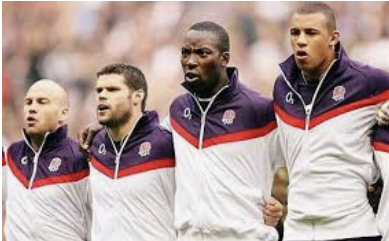
In recent years the development pathway with London Irish results in most players moving on as U16-U18.
Who are the most successful Alumni (Juniors) who subsequently moved into the professional game?
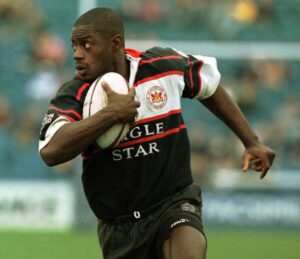
We have had several players who have progressed through our junior and sections and gone onto represent at higher levels. Audley Lumsden moved from Reading” to Bath, England Student, England B and Oxford University Blue. He later went onto to play and coach at Gloucester in the professional era.
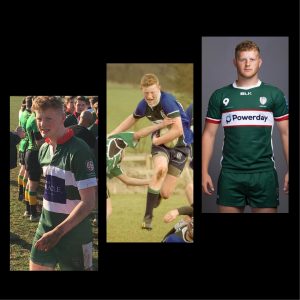
In most recent years we have three players in Josh Smart as well as brothers Ben and Jacob Atkins who have come through the junior sections of the club before signing for London Irish. Both Ben and Josh have also gone both gone on to represent England U20’s.
In our girls section both Alex Matthews (now Worcester) and Abi Dow (Wasps) both started their rugby at Reading, progressed through Berkshire and are currently in the national Premier 15’s Women’s league and England Red Roses regulars.
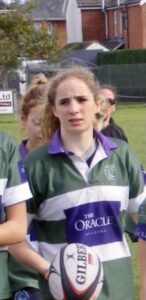
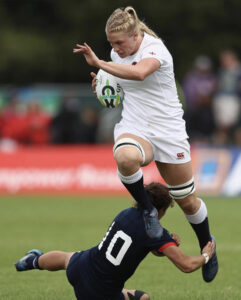
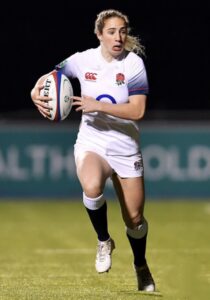
In the current girls section (Season 2020/21) we have two girls (Caitlyn Clark and Millie Whitehouse who as well as playing for Reading RFC (to maximise game time) also are in the Wasps COE (Centre of Excellence) have both been selected for the England U18 TDG (Training Development Group)
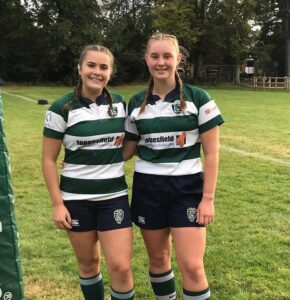
When were the glory years? Men, Women, Youth etc?
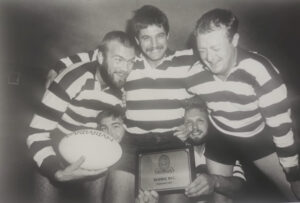
Notwithstanding the years when our senior men’s team were in the Top 30 clubs in the country and voted World Club of the Month (September 1986).
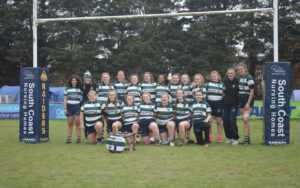
Most recently we are very proud of our U18 Girls who were losing semi-finalists in the National Knockout in 2019.
What league (Level) do Reading play in now? Men & Women (Levels and league names)
The Men’s 1s play Level 7, Southern Counties North – same league as Reading Abbey, Wallingford and Thatcham while the Women’s team play Level 4 – NC1 South East (North) – mostly London teams, plus Windsor and Chesham.
What happened to the famous stand?
In 1985 the then coach Geoff Owen looked at the old concrete frames that had been lying around in the corner of the ground for some years, they seemed in good condition with no evidence of corrosion of the steel reinforcing. He chatted to Gordon Richens about re-erecting the grandstand and after a discussion about positioning they agreed to erect the stand..
We put together a small budget for rafters, roof sheeting and timber for seating. Reading did all the manual work ourselves. So with help from the first team & other players and Ron Hunter’s guys (including Craig & the three Canadians players who Ron employed when they came over to us after the Canada tour) we built the stand.
The only problem we had was that the frame was erected when we were away in Canada in 1986 and Gordon Richens’ guys put the back of the stand where the front should have been, consequently it was always too close to the pitch. However we decided to live with it rather than take the whole frame down again.
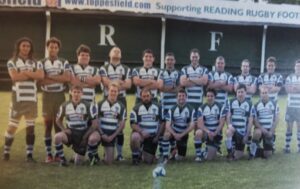
The times the stand must have been full were probably when we had big crowds watching us when we played sides in higher divisions in the RFU Knockout Cup. The stand was finally taken down in 2020 given the maintenance costs and its limited use.
Who are the clubs biggest sponsors?



Who is your longest serving current player?
The longest serving player was Danny Pratt who played over 800 games across the many senior sides (inc Vets) over the years. The record for 1st team XV appearances is as follows;.
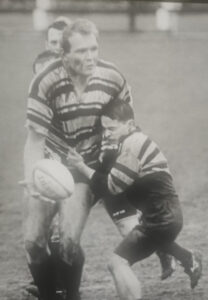
CAREER RECORDS – Most 1st XV games
| Player | Position | P | Started | Replacement | T | C | PENS | PTS |
| Danny Pratt | 2nd Row | 350 | ||||||
| Andrew Grierson | Prop | 259 | 214 | 45 | 17 | – | – | 85 |
| Mark Vatcher | 2nd Row | 252 | 239 | 13 | 30 | – | – | 150 |
| Alex Dorliac | Fullback | 223 | 216 | 7 | 114 | 46 | 11 | 695 |
| Chris Greig | Wing | 181 | 179 | 2 | 109 | – | – | 545 |
| Paul Fisher | Prop | 173 | 165 | 8 | 31 | – | – | 155 |
| Sean Kenneally | 2nd Row | 173 | 169 | 4 | 20 | – | – | 100 |
| Steve King | Hooker | 160 | 121 | 39 | 20 | – | – | 100 |
What might people not know about Reading Rugby Club?
Reading is a large town with a very diverse population – and our membership reflects that. We are also progressive and inclusive in our attitudes (before Diversity & Inclusion was a thing), as shown by:
- One of the pioneers of Veterans rugby, with the Rhinos founded in 1986;
- Women’s rugby going for thirty years, as the Kites were started in 1990;
- Pioneers of Walking Rugby in the South East, getting going in 2015;
- The first Thames Valley Mixed Ability Rugby team, with the Brigands started this year (2019)
- Having its first woman President in the county (2019)

Mixed Ability Rugby Team 
Reading Walking Rugby 
Reading RFC President – Yasmin Miller 
Reading Girls Rugby
What other clubs are active at Reading Rugby Club?
Our club at Holme Park is the base for other sports and community activities:
- Didi Rugby (18mths to 6 years)
- Reading & District Amateur Radio Club
- Twyford & District Fishing Club
- Women’s Personal Training
- Reading Jazz Club
- Reading Rugby Club Golf Society (Golf Society who raise funds for the club)
- Reading Blue Coat School – pitch sharing and use of the Club’s S & C Gym
What is the clubs speciality post-match meal?
Gina is our head of catering and the players and travelling players will be aware of her famous “Pasta Carbonara” but most parents will know that as per most clubs her bacon sandwiches and investment in “proper” coffee is a delight on a Sunday morning.
What is the clubs house beer?
Reading are pleased to have our own branded IPA called “Green Machine” and is based upon Greene Kings IPA.
What one thing could Berkshire or England Rugby do for Reading RFC and other community rugby clubs?
Fund the Artificial Grass Pitch (AGP) scheme that was scheduled to come to Reading RFC, but fell foul of the RFU’s cost reduction programme (pre-Covid). Berkshire is one of the few counties not to have an AGP as part of the 2015 RWC Legacy Programme.
Thanks to Ted Goodhew, Stuart Spindler and Danny Pratt for providing the information.
CONTACT DETAILS
https://www.pitchero.com/clubs/readingrugbyclub/contact
22/12/2020